
The Reserve Bank of India (RBI) has proposed new rules under the Lead Bank Scheme to make it easier for people and businesses to get loans, especially in smaller towns and villages. The aim is to improve access to credit, especially for farmers, small businesses, and people in remote areas.
According to the proposed guidelines:
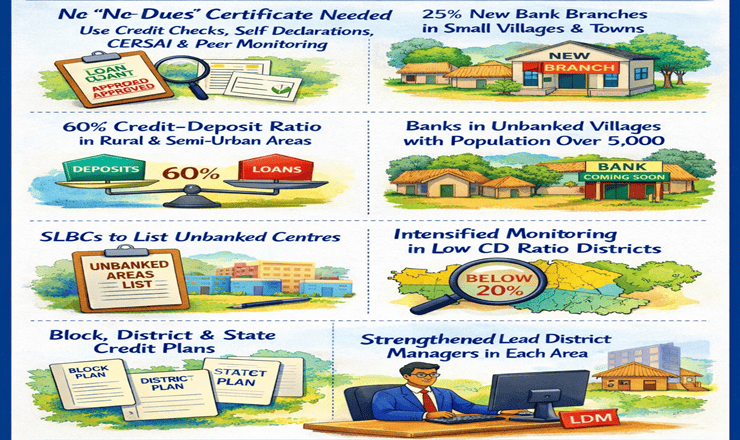
- Banks will no longer ask for ‘no dues’ certificates(a document proving you have no pending loans) from borrowers. Instead, banks can check loan history using credit bureaus, self-declarations, CERSAI records, or local monitoring. This change is meant to save time and prevent delays in getting loans.
- The RBI has also told banks to open at least 25% of their new branches in small towns and rural areas (tier 5 and tier 6 areas). This will help people in these areas get banking services closer to home. State Level Bankers’ Committees will keep and publish updated lists of such unbanked areas, while district-level groups will track progress.
- Banks must maintain a 60% Credit-Deposit (CD) ratio in rural and semi-urban areas. This means a good portion of the money deposited in these areas should be given back as loans locally. This is meant to make sure that local deposits are used to support local development. Districts where lending is very low will be closely monitored, especially those with credit-deposit ratios below 40% or even 20%. For such districts, special action plans will be prepared to boost lending and improve access to credit.
- Villages with a population of more than 5,000 people but no bank branch will be given first priority for opening new banking outlets, so that people there can easily access banking and loan services.
-
State Level Bankers’ Committees (SLBCs) must prepare and regularly update a public list of unbanked villages and towns and District-level committees will closely monitor how banking services and credit are expanding in their areas.
- Banks have been instructed to strengthen the role of Lead District Managers (LDMs). Every district must have a dedicated officer with enough staff, technology, and infrastructure to improve coordination between banks and help expand financial inclusion.
- Banks must follow bottom-up credit planning. This means banks have to plan lending in a step-by-step way, starting from the village and block level and then moving up to the district and state level. Instead of top-level decisions only, local needs will be considered first. These credit plans will follow fixed deadlines and will be closely monitored to make sure banks actually implement them on time.
Overall, these changes are meant to make loans easier to get and expand banking services in rural India. Banks will open more branches in rural areas and reduce unnecessary paperwork, so people don’t have to run around for documents. The idea is to ensure money reaches priority sectors instead of getting stuck due to paperwork or lack of planning.