
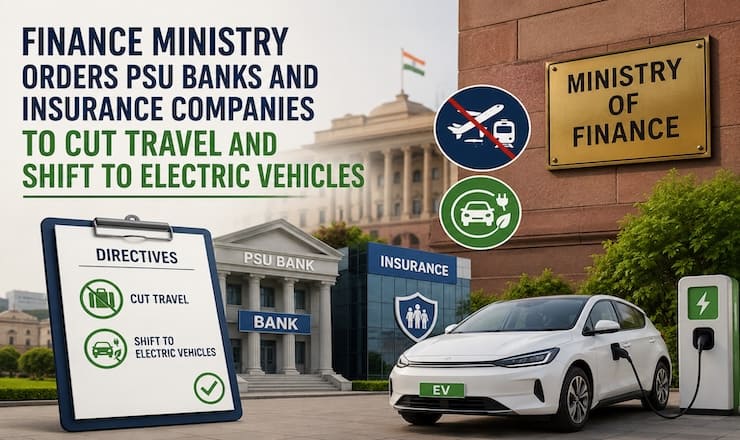
India’s public sector financial giants are about to operate leaner. The Union Finance Ministry has directed state-run banks, insurance companies, and financial institutions to implement a series of cost-cutting measures — including restrictions on travel and the gradual replacement of petrol and diesel vehicles with electric vehicles.
Who Does This Apply To?
The order, issued by the Department of Financial Services, covers major institutions like State Bank of India, Bank of Baroda, and Life Insurance Corporation of India, along with millions of their employees across the country.
What Exactly Has Been Ordered?
The directive lays out three clear mandates:
Virtual Meetings First — All meetings, reviews, and consultations must be conducted via video conferencing unless physical presence is deemed absolutely essential.
Curb Foreign Travel — Foreign travel by top executives — including chairpersons, managing directors, and CEOs — must be kept within prescribed limits, with overseas engagements to be attended virtually wherever possible.
Switch to EVs — All PSU organisations are expected to replace petrol and diesel vehicles used at head offices and branch offices with electric cars as much as feasible.
Why Now?
This move follows Prime Minister Narendra Modi’s call last week for austerity and spending restraint, as the government braces for economic fallout from rising global tensions. The directive is part of a broader nationwide push to rein in non-essential government expenditure.
The Big Picture
This isn’t just about saving fuel or cutting bills — it signals a clear shift in how the government wants its financial institutions to operate: digitally-first, fiscally disciplined, and environmentally conscious. For banks like SBI and insurers like LIC, which run massive vehicle fleets and have executives constantly on the move, this directive will have real operational implications.
It also aligns with India’s larger EV adoption goals, nudging public sector behemoths to lead by example in the green transition.