
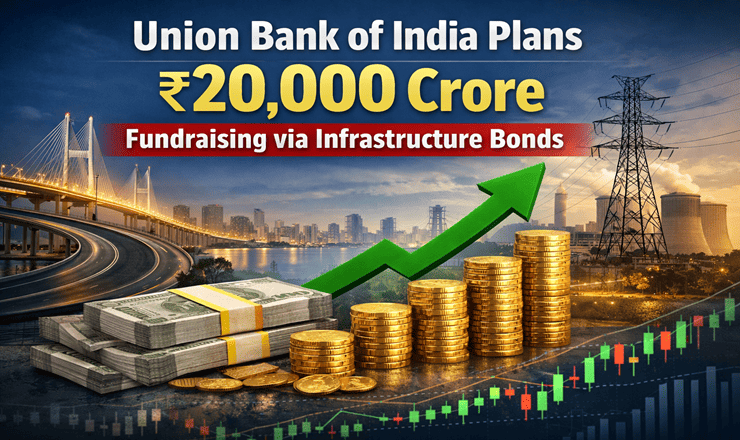
Union Bank of India (a government-owned bank) wants to collect money from investors. The bank wants to raise ₹20,000 crore. It will do this by issuing infrastructure bonds. These are long-term bonds, meaning the bank will repay after many years.
Infrastructure bonds are a way for a bank to borrow money from people. When people or big investors buy these bonds, they are giving their money to the bank. In return, the bank promises two things: it will pay investors extra money, called interest, at regular intervals, and it will also return the full amount of money after a fixed period of time.
How the money will be raised?
The bank plans to raise a total of ₹20,000 crore, but it will not take all the money at once. Instead, it will raise the money step by step in parts, which are called tranches.
In the first step, the bank plans to raise ₹7,500 crore before March 31, 2026. Out of this, ₹3,000 crore is the fixed (base) amount. The remaining ₹4,500 crore is an extra option, called a green shoe option, which means the bank can raise this additional amount only if there is strong demand from investors. Also, these bonds will have a duration of 10 years, which means the bank will return the money after 10 years.
As part of an extra plan, the bank may raise ₹5,000 crore by issuing green or sustainable bonds. These are special bonds where the money is used only for environment-friendly projects. This includes things like renewable energy (such as solar or wind power), clean transportation, and projects that help reduce pollution.
The bank wants to raise money to support infrastructure projects. These are large development projects that help improve the country, such as building roads, bridges, power plants, and other important facilities.
The share price of Union Bank of India has shown mixed performance recently, meaning it has gone up and down in the short term because the overall market is a bit weak. In the last 1 month, the stock has fallen by about 3.47%, but since the beginning of this year (YTD), it has still increased by around 15%.