Imagine studying hard for an exam, only to find out the teacher made mistakes while grading your paper. Frustrating, right?
Something similar happens in the financial world. You work hard to pay your EMIs on time and build a good credit score, but what if the companies keeping track of your “financial report card” make errors?
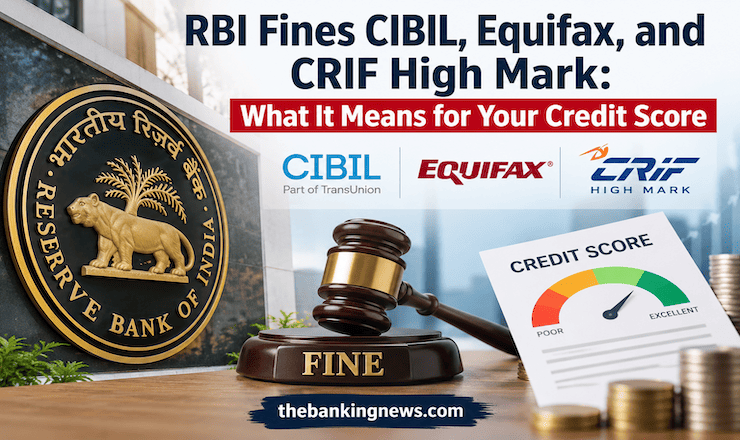
To ensure these companies don’t mess up your financial reputation, the Reserve Bank of India (RBI) recently stepped in and imposed penalties on major Credit Information Companies (CICs), including TransUnion CIBIL, Equifax, and CRIF High Mark.
If you are wondering what this means for your wallet and your future loans, don’t worry. We have broken it all down into simple, easy-to-understand points.
Who are CIBIL, Equifax, and High Mark?
Before we talk about the penalties, let’s understand who these companies are.
Whenever you take a loan or use a credit card, your bank shares your repayment history with Credit Information Companies (CICs). In India, the RBI licenses four major CICs: CIBIL, Equifax, Experian, and CRIF High Mark.
These companies collect your financial data and calculate your Credit Score (usually a number between 300 and 900). Banks look at this score before approving your home loan, car loan, or credit card. Simply put, they are the “scorekeepers” of your financial life.
Why Did the RBI Impose Penalties?
The RBI acts as the watchdog of the Indian financial system. Its job is to protect consumers and ensure banks and financial institutions play by the rules.
The RBI imposed monetary penalties on CIBIL, Equifax, and CRIF High Mark for non-compliance with regulatory guidelines. While the exact legal jargon can be heavy, here is what it means in plain English:
Data Accuracy Issues: The CICs were found lacking in ensuring that the credit data they hold is 100% accurate and updated on time. If you paid your EMI, but the CIC’s system showed a delay, it unfairly hurts your score.
Poor Grievance Redressal: If a consumer finds an error in their credit report and complains, the CIC is supposed to fix it quickly. The RBI found that these companies were not resolving customer disputes within the mandated time limits.
Regulatory Breaches: They failed to strictly follow certain directives laid out by the RBI to protect consumer rights and maintain transparency.
Because they broke these rules, the RBI hit them with financial fines to send a strict message: Take consumer data seriously.
The Fine Breakdown
The penalties, imposed on August 31, 2026, reflect the severity of the non-compliance:
TransUnion CIBIL: ₹26,82,800
CRIF High Mark Credit Information Services: ₹6,89,600
Equifax Credit Information Services: ₹1,19,400
Sammaan Finserve: ₹4.20 lakh
Hinduja Leyland Finance: ₹6.20 lakh
What Does This Mean for YOU?
You might be thinking, “The RBI fined the companies, but how does this affect me?”
Actually, this is great news for you as a borrower. Here is why:
Better Accuracy: Because of the strict RBI action, these credit bureaus will now be much more careful. You can expect fewer errors in your credit reports.
Faster Complaint Resolution: If you spot a mistake in your CIBIL, Equifax, or High Mark report, these companies are now under high pressure to fix your issue quickly. Their customer support and dispute resolution systems will likely improve.
Fairer Loan Approvals: With cleaner and more accurate credit data, you won’t be rejected for a loan just because of a technical error made by a credit bureau.
What Should You Do Now?
While the RBI is keeping these companies in check, you still need to take charge of your own financial health. Here are three quick steps you should take today:
Check Your Credit Report: You are allowed to check your credit report for free. Download your report from CIBIL, Equifax, or High Mark (you only need to check one, as the data is largely similar, but checking multiple is a good habit).
Spot the Errors: Look closely at your loan accounts, credit card dues, and personal details. If you see a loan you never took, or an EMI marked as “late” when you paid it on time, flag it immediately.
Raise a Dispute: If you find an error, don’t ignore it. Go to the respective CIC’s website and raise a “Dispute Resolution” request. They are now legally bound to resolve it quickly.
Your credit score is your financial passport. A good score can save you lakhs of rupees in interest over your lifetime.
The RBI’s penalty on CIBIL, Equifax, and CRIF High Mark is a strong reminder that your financial data is precious. The watchdog is barking, and the scorekeepers are now on their best behavior. Keep checking your credit reports, keep paying your dues on time, and let your good financial habits shine!