
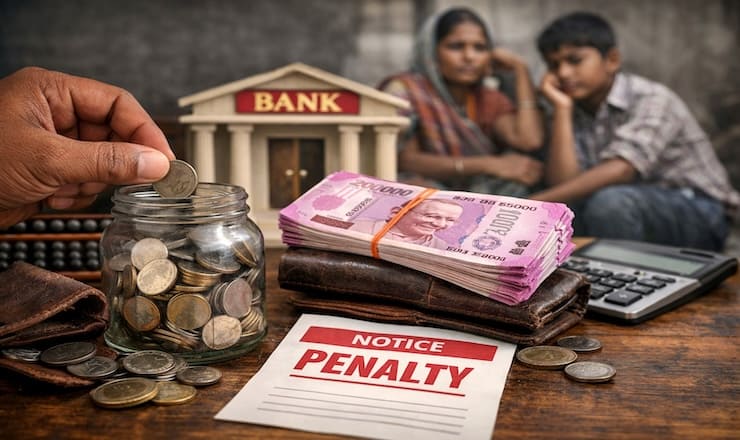
A recent tweet by Raghav Chadha has sparked debate over the impact of minimum balance penalties imposed by banks. According to him, in the last 3 years, banks have charged customers ₹19,083 crore as penalties. This penalty is charged for things like late payments, not maintaining minimum balance, etc. Both government and private banks earned a lot of money from penalty charges, but private banks collected more than public banks during this period.
Out of the total money collected as penalties, government banks (public sector banks) took about ₹8,092.83 crore. The rest of the money (about ₹10,990 crore) was collected by private banks.
Chadha highlighted that these penalties do not primarily affect wealthy individuals or large borrowers. Instead, they disproportionately impact economically weaker sections, including farmers, pensioners, and daily wage workers. He pointed out that even small financial shortfalls—such as withdrawing money for essential needs like medicine or falling short by a few hundred rupees—can result in penalty charges.
Through his message, Chadha questions the fairness of such banking practices. He argues that people deposit money in banks for safety and security, not to be penalized for having limited funds. The tweet emphasizes that financial inclusion policies should aim to protect small savers rather than burden them with additional charges.
The broader concern raised is whether current banking rules are aligned with the goal of supporting vulnerable sections of society, or if they unintentionally penalize those who are already financially strained.
Critics argue that “Banks should help poor people save money, not punish them for having less”. Some people are saying that banks should remove or reduce these penalties and should make banking more friendly for small and poor customers.
What are the rules right now?
Banks set their own rules for how much money customer must keep in their account (minimum balance). If the balance goes below that limit, the bank may charge a penalty. But there’s an exception like zero-balance accounts. In these accounts, customers don’t need to maintain any minimum balance, so no penalty is charged.
Banks say that these charges help them pay for the cost of running and maintaining your account. But critics say: this creates extra pressure on people with less money, because they may end up paying fines even when they’re already struggling financially. This has started a debate on whether such charges are fair or not.