What Is OneTag?
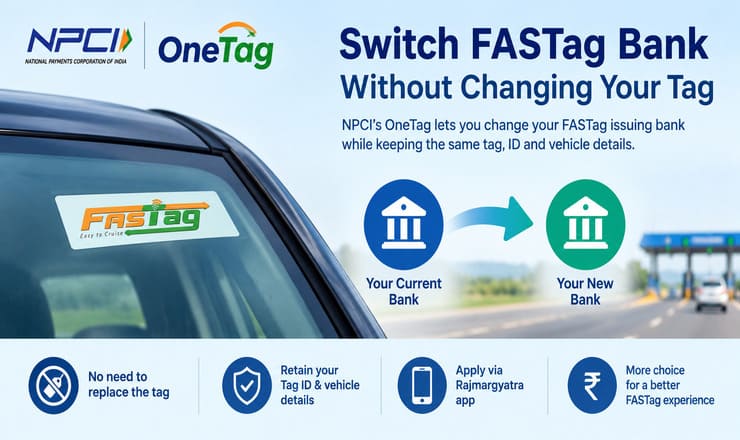
The National Payments Corporation of India (NPCI), in collaboration with Indian Highways Management Company Limited (IHMCL), has introduced OneTag, a portability solution for National Electronic Toll Collection (NETC) FASTag users. The initiative allows eligible customers to change their FASTag issuing bank without replacing the physical FASTag already affixed to their vehicle.
Union Minister for Road Transport and Highways Nitin Gadkari launched OneTag at the Global Fintech Fest (GFF) 2026 in Mumbai on 11 September 2026. The service became available through the National Highways Authority of India’s (NHAI) Rajmargyatra mobile application on 17 September 2026.
Under the new facility, users can retain their existing FASTag, Tag ID and vehicle registration number while moving their FASTag service to another issuer bank. This removes the need to close the existing arrangement and obtain a new physical tag simply to change banks.
Why Was OneTag Introduced?
FASTag uses Radio Frequency Identification (RFID) technology to collect toll payments electronically as vehicles pass through toll plazas. The NETC system enables FASTags issued by different participating banks to work across the national toll network.
Before OneTag, customers who wanted to change their FASTag issuer generally had to close the existing tag, complete fresh onboarding and obtain a replacement tag. This process could involve additional paperwork, waiting time and the inconvenience of removing or replacing the sticker on the vehicle’s windscreen.
OneTag addresses this problem by extending portability to the issuing bank while retaining the existing physical tag.
The initiative is designed to improve customer choice, simplify issuer changes, reduce repeated tag production and lower the operational costs associated with dispatch and reissuance.
Key Features of OneTag FASTag Portability
The main features of the OneTag facility are:
Change the issuing bank: Eligible customers can move their FASTag service to another issuer.
Retain the existing physical tag: There is no need to replace the FASTag sticker on the vehicle.
Keep the same Tag ID: The existing FASTag ID and linked vehicle registration number remain unchanged after successful portability.
Access through Rajmargyatra: Customers can initiate the process using NHAI’s mobile application.
Secure verification: The process includes eligibility checks, customer consent and verification through the existing issuer.
Manage the old wallet: The previous issuer closes the old FASTag wallet and refunds the available balance after applicable adjustments.
Six-month cooling period: A FASTag that has been ported cannot be ported again during the following six months.
How to Change Your FASTag Issuing Bank Through OneTag
Eligible FASTag users can initiate the portability process through the Rajmargyatra mobile application.
Step 1: Log in to the Rajmargyatra app
Open the Rajmargyatra app and log in to access the FASTag portability facility.
Step 2: Check eligibility
Enter your vehicle registration number to check whether the existing FASTag is eligible for portability.
Step 3: Verify your request
The existing issuer bank provides a six-digit Mobile Verification Code (MVC) for authorising the portability request. Complete the verification and consent process as instructed.
Step 4: Select the new issuer bank
Choose the preferred FASTag issuer from the available options in the application.
Step 5: Complete onboarding
Complete the required customer verification and wallet onboarding formalities with the new issuer bank.
Step 6: Continue using the same FASTag
Once portability is successfully completed, the existing Tag ID and vehicle registration number remain unchanged. The new issuer takes over the FASTag service, allowing the customer to continue using the same physical tag.
Customers should follow the status and instructions shown in the Rajmargyatra app throughout the process.
What Happens to the Existing FASTag Wallet Balance?
Portability does not mean that the old wallet balance is automatically transferred into the new issuer’s wallet.
After successful portability, the previous issuer closes the existing FASTag wallet and refunds the available balance after making applicable adjustments. Customers should check the refund and settlement details with their existing issuer and complete the required wallet onboarding with the new bank.
Any pending transactions, disputes or other unresolved matters should be checked before initiating the switch.
Important Conditions FASTag Users Should Know
Before requesting portability, customers should keep the following points in mind:
Eligibility is required: Not every FASTag may qualify. Check the vehicle and tag status through the Rajmargyatra app.
Verification is necessary: Customers need to complete the prescribed authorisation and consent process.
The old wallet is closed: The previous issuer handles the closure and refund of the available balance, subject to applicable adjustments.
A six-month cooling period applies: Customers cannot port the same interoperable FASTag again during the six months following portability.
Complete the new issuer’s onboarding: Selecting a bank alone does not complete the switch; the required verification and onboarding must be successful.
Customers should also ensure that their registered mobile number is accessible and resolve any outstanding tag-related issues before beginning the process.
Benefits of OneTag for Customers and Banks
Benefits for FASTag users
OneTag gives customers greater flexibility when choosing a FASTag issuer. A customer dissatisfied with an issuer’s service can explore another participating bank without replacing the sticker on the vehicle.
The facility also reduces the inconvenience associated with obtaining a new tag and completing a fresh registration process. Retaining the existing Tag ID and vehicle registration details makes the transition simpler.
Benefits for banks and the NETC ecosystem
For issuer banks, portability introduces a more streamlined process for customer migration. Banks can compete for FASTag customers on service quality and customer experience, subject to the applicable portability framework.
For the broader NETC ecosystem, reducing the need to manufacture, dispatch and reissue physical tags can lower operating costs and material waste.
NPCI provides the central technology framework for portability and updates the issuer details in the NETC system. Toll acquirers and toll plazas continue to process transactions through the existing NETC framework.
OneTag and the Future of Digital Toll Collection
The introduction of OneTag is a further step in the development of India’s electronic toll collection infrastructure. FASTag has already made toll payments more convenient by enabling electronic deductions without requiring cash payments at toll booths.
By allowing customers to change their issuing bank while keeping the same physical tag, OneTag adds flexibility to the existing system. It also supports a more customer-oriented approach to managing digital payment services.
The initiative forms part of the broader effort to improve highway travel through technology, including the longer-term goal of barrier-free tolling and reduced waiting times.
NPCI’s OneTag FASTag portability solution gives eligible users the option to switch their issuing bank without replacing the FASTag affixed to their vehicle. Available through the Rajmargyatra app, the facility retains the existing Tag ID and vehicle registration number while transferring the service to a new issuer.
For customers, the main advantage is greater choice with less inconvenience. For banks and the NETC ecosystem, it offers a more streamlined way to manage issuer changes and reduce repeated physical tag issuance.
FASTag users considering a switch should check their eligibility, review the old wallet balance and complete all verification and onboarding requirements before relying on the new issuer for toll payments.